
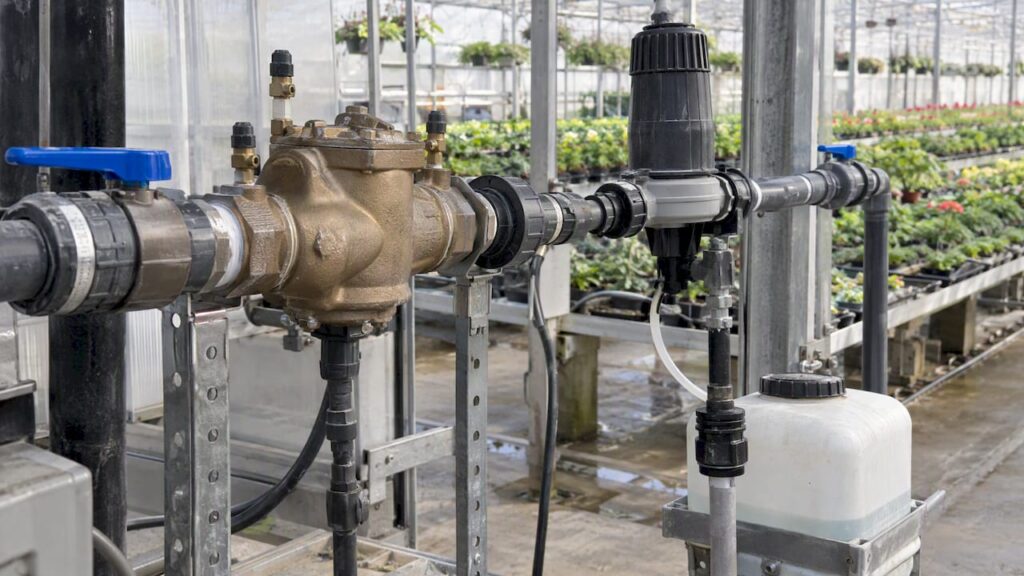
If you inject fertilizer into irrigation water on a New Jersey property, you need a backflow preventer between that system and the drinking water supply. It has to be the right type, installed correctly, tested every year by a certified tester, and repaired or replaced if it fails. This guide explains why, which rules apply, what the device must look like, and what to do when a test goes badly.
It is written for property owners and property managers with greenhouses, nurseries, landscaped grounds, or irrigation systems that carry fertilizer. If you only have a lawn sprinkler with no injector, most of this still applies, but the stakes are lower.
TL;DR
- Fertigation means feeding plants through irrigation water. If the system loses pressure, fertilizer can flow or be siphoned back toward the water source.
- In New Jersey, a physical connection between a public potable supply and an unapproved water supply needs a permit, and the state’s rules require an approved backflow device, either a double check valve assembly or a reduced pressure zone (RPZ) assembly.
- Testable devices that isolate cross-connections are tested before final inspection and annually, by a tester certified through an agency recognized by NJDEP. One- and two-family dwellings are exempt from the annual test.
- A device that fails must be repaired or replaced, and replacement needs a permit.
- Add check valves, an air-vacuum relief valve and an injector interlock on the fertilizer side, because the main device is not your only line of defense.
Table of Contents
- What fertigation is and why it creates a backflow risk
- What New Jersey requires
- Which device protects a fertigation system
- Testing: how often, by whom, and how it is reported
- What to do if the device fails
- Operating precautions on the fertilizer side
- Our perspective
- What it costs
- Book testing for your fertigation system
- A checklist before the tester arrives
- FAQ
- Sources
What fertigation is and why it creates a backflow risk
Fertigation is applying fertilizer by injecting it into irrigation water. It is efficient. Nutrients reach the roots in small, frequent doses, and you can dial concentrations up or down by crop. Greenhouses, nurseries, drip-irrigated gardens and large managed landscapes all use it.
The risk comes when the water stops. University of Minnesota Extension notes that chemicals can flow or be siphoned back into the irrigation water source when the system shuts down. A main break down the street, a pump failure, a fire hydrant being opened nearby: any of these can drop pressure in the supply line. If your irrigation piping is tied into the building’s potable plumbing, fertilizer-laced water can be pulled the wrong way, into pipes people drink from.

That is a cross-connection, and it is what backflow preventers exist to stop. A small hose-bib vacuum breaker is not enough when a chemical injector is involved. You are dealing with a real contaminant at a concentrated point in the system, which is why the level of protection scales with the hazard.
Where the hazard shows up on real properties
In practice we see fertigation backflow questions in a handful of settings:
- Greenhouses and nurseries with injector pumps or proportional dosers feeding benches or drip lines.
- Commercial and HOA landscapes where a hose-end or inline fertilizer injector is attached to the irrigation mainline.
- Multi-unit properties where one irrigation connection serves common grounds and the owner or manager is responsible for the device.
- Homes with a fertilizer injector added to an otherwise standard sprinkler system.
What New Jersey requires
There is no single “fertigation law” in New Jersey. Instead, several state rules fit together, and which one drives your obligations depends on how the system is connected.
The physical connection rules
NJDEP’s guidance says a physical connection between an approved public potable water supply and an unapproved water supply requires a permit, and that applicable rules require backflow-device design and testing. The same guidance describes a facility with cross-connection hazards as one served by a public community water system that contains a chemical, uses a process, or uses water in a manner that might contaminate that system through a cross-connection. A fertilizer injector fits that description squarely.
Greenhouses
The New Jersey Department of Agriculture’s guidance for temporary greenhouses says that a plumbing subcode permit is required for a backflow device when the irrigation system is connected to a potable water supply, and a New Jersey licensed plumber must install it. That fact sheet speaks to temporary greenhouses specifically, so if your structure is permanent, confirm the permit path with your local construction official before you buy or install anything.
Your water purveyor
Municipal and private water companies often run their own cross-connection control programs on top of state rules, with their own forms and deadlines. Whoever sends your water bill is a good first call. Test reports are generally filed with the purveyor or the local plumbing subcode official, depending on the program.
Which device protects a fertigation system
The state’s administrative code is direct on this point. Under N.J.A.C. 7:10-10.3, an approved physical connection installation must consist of either a double check valve assembly or a reduced pressure zone (RPZ) backflow preventer. The rule ties the choice to the water on the other side: an RPZ is required when the unapproved water supply is non-potable or exceeds state contaminant limits.
How to read that for fertigation
| Situation | Typical level of protection |
|---|---|
| Irrigation water is potable-quality and no chemical is injected | Double check valve assembly may be acceptable where the code allows it |
| Fertilizer or other chemicals are injected into the line | RPZ assembly is the conservative choice and what most purveyors expect |
| Source water is non-potable or fails state contaminant limits | RPZ is required |
The table is a rule of thumb, not a ruling. The final call belongs to your water purveyor or plumbing subcode official. Because a fertilizer injector adds a chemical to the water, we generally plan for an RPZ on these systems and let the local authority tell us if less is acceptable.
Installation details that get properties in trouble
The same code section spells out the build. Installations must include test cocks, devices up to two inches need full-port ball-type shutoff valves, and RPZ relief piping must allow an air gap between the assembly and the drain pipe. Devices must also be built from durable, non-toxic materials such as stainless steel, bronze or brass.
Three mistakes come up again and again:
- Plumbing the RPZ relief port directly into a drain. The air gap matters. Without it, a drain backup can become a new route for contamination.
- Installing the device in a pit or low spot. An RPZ discharges when it needs to. If it sits where it can flood, the point of the device is defeated, and testers cannot reach it safely.
- Skipping test cocks or shutoff valves. If a tester cannot isolate and test it, it cannot be certified.
If the device sits outside, a protective enclosure keeps it from freezing, being struck by equipment, or being tampered with. Our guide to enclosure requirements in New Jersey covers what the rules say.
Testing: how often, by whom, and how it is reported
The state’s plumbing code bulletin lays out the testing rhythm. Testable devices isolating cross-connections must be tested before final inspection and annually, except that one- and two-family dwellings are exempt from annual testing. If you manage a farm, a commercial greenhouse, a multi-unit building or a commercial landscape, plan on the annual test.
Who may test
The same bulletin says the tester must be certified by an agency recognized by the NJDEP Bureau of Safe Drinking Water. NJDEP publishes the list of approved certifying agencies for backflow testers, and the most current list of individual certified testers comes from those agencies. Before you hire anyone, ask for their certification and confirm it is current.
What happens after the test
Per the bulletin, the owner may submit the test certification to the plumbing subcode official, who issues a one-year Certificate of Compliance once passing results are received. Keep that certificate with your property records. If a purveyor or inspector asks for proof, you will want it on hand.
For property managers with many sites, the real work is tracking. Each device has its own due date, its own purveyor and sometimes its own paperwork. Our property manager backflow compliance guide explains how to confirm that filings actually reached the right office.
What to do if the device fails
A failed test is common, especially on older assemblies exposed to debris from irrigation water. The rule is simple: a device that fails must be repaired or replaced, and a permit is required for replacement.
Here is the usual sequence:
- Get the failure in writing. The test report should state which component failed, such as a check valve or relief valve.
- Decide repair or replace. Worn seats, discs and springs are often fixed with a rebuild kit. A cracked body, a wrong-size device or a model no longer approved points toward replacement.
- Retest after the work. A repair is not complete until the device passes.
- File the passing result. Send it to the right authority so your compliance record is current.
- Pull a permit if you replaced the unit. Our walkthrough of the backflow replacement permit process in NJ shows what to file.
If you received a notice from your water purveyor or code office, read our page on what to do after a backflow violation notice in NJ before the deadline passes.
Operating precautions on the fertilizer side
The main backflow device protects the public water. It does not protect your own crop or your own irrigation pipes from every mistake. University of Minnesota Extension’s chemigation guidance, written for agricultural irrigation, recommends that for fertilizer chemigation you use an approved main-pipeline check valve, an injection-line check valve, an air-vacuum relief valve, and an interlock that stops injection when irrigation stops. It also says to inspect components before each use and repair or replace anything that is not working.
That guidance comes from Minnesota, so treat it as good practice, not New Jersey law. It still maps well to a New Jersey greenhouse or landscape. A practical routine looks like this:
- Before each season: have the backflow assembly tested, and inspect the injector, tubing and check valves for cracks or residue.
- Before each fertigation run: confirm the interlock works and the injection check valve seats properly.
- After any pressure event: if the system lost pressure unexpectedly, check the relief port of the RPZ and look for discharge.
- At shutdown for winter: drain or protect the assembly so freezing does not crack the body.
The same source adds that the operator and the farm manager or owner are responsible for minimizing pollution risks through proper safety devices and management. On a managed property, that responsibility sits with you, not with the contractor who last touched the system.
Our perspective
Most of the fertigation backflow calls we get start the same way. Someone added an injector years ago, the original backflow device was sized for a plain sprinkler zone, and nobody has looked at the paperwork since. The device may pass, but the permit trail is missing, or the relief port drains into a spot that fails the air gap rule.
Our advice is to treat the injector as the thing that sets your protection level, not the sprinkler. If chemical goes into the line, plan around an RPZ, give it room to discharge, put it somewhere a tester can reach, and enclose it if it lives outdoors. Then set one calendar date each year for testing and stick to it.
We are a family-owned, licensed and insured New Jersey company. We stock OEM parts so that many repairs and rebuilds can be completed in the same visit, and we can file test reports directly with the water authority so you are not chasing paperwork. For property managers, we offer consolidated billing across multiple properties.
— Jordan
What it costs
The prices below are what we publish on our FAQ page. Your final price depends on the device size, access and condition.
| Service | Published price |
|---|---|
| Annual residential certification test | $150–$250 |
| Commercial device testing | $200–$450 per device |
| Rebuild kit service (residential) | $125–$250 |
| Protective enclosure installation | $200–$500 |
| Residential installation | $300–$800 |
Rebuilds and repairs for commercial devices, and custom enclosures, are quoted per job. For a broader look at planning annual costs across several sites, see our backflow testing budget guide for property managers, and for installation and rebuilding pricing details see our cost breakdown.
Book testing for your fertigation system
If you have an injector tied into a New Jersey water supply and cannot point to this year’s passing test, schedule it now. We offer backflow preventer testing and certification across New Jersey, with same-day service available, repairs and rebuilds done with OEM parts, and reports filed with the water authority for you. You can also contact us directly with your address and a description of your system.
A checklist before the tester arrives
A little preparation saves time and often money on the visit.
- Locate every device. Properties with a greenhouse, a lawn system and a separate fire line may have several assemblies. Walk the site and list each one.
- Note the make, model, size and serial number. This is stamped on the body and goes on the test report.
- Clear access. Trim shrubs, remove debris and unlock gates or enclosures.
- Gather prior reports and permits. If a past test or permit exists, have it ready so the tester can match records.
- Tell the tester about the injector. The type of chemical, where it is injected and whether it has check valves all matter to a proper assessment.
- Plan for a brief shutoff. Testing interrupts water to the irrigation line, so schedule it when no run is underway.
If your property is in one of our counties, our local pages cover details for Monmouth County, Passaic County, Hudson County and Warren County.
FAQ
Do I need a backflow preventer if I only have a small fertilizer injector on my sprinkler system?
Yes, in practice. A fertilizer injector adds a chemical to a line connected to potable water, which is exactly the cross-connection hazard NJDEP’s guidance describes. Ask your water purveyor or plumbing subcode official what level of protection they require, and expect an RPZ to be the safe choice.
Is my single-family home exempt from annual testing?
New Jersey’s plumbing bulletin exempts one- and two-family dwellings from the annual test requirement. Your water purveyor may still ask for testing, and a device protecting an injector is worth checking yearly regardless. Confirm with your local office.
Who can legally test my fertigation backflow preventer?
Only a tester certified by an agency recognized by the NJDEP Bureau of Safe Drinking Water. Ask for the tester’s current certification before the visit. NJDEP publishes the list of approved certifying agencies on its website.
What happens if my device fails the test?
It must be repaired or replaced, and replacement requires a permit. After the fix, the device is retested and the passing result is filed. Once the plumbing subcode official receives passing results, a one-year Certificate of Compliance can be issued.
Do I need an enclosure for an outdoor device?
An enclosure is not what makes a device legal, but it protects the assembly from freezing, damage and tampering. In New Jersey winters it often pays for itself. Our enclosure requirements page explains what the rules say.