
FAQ
How Long Does a Backflow Test Take, and Do I Need to Be Home?
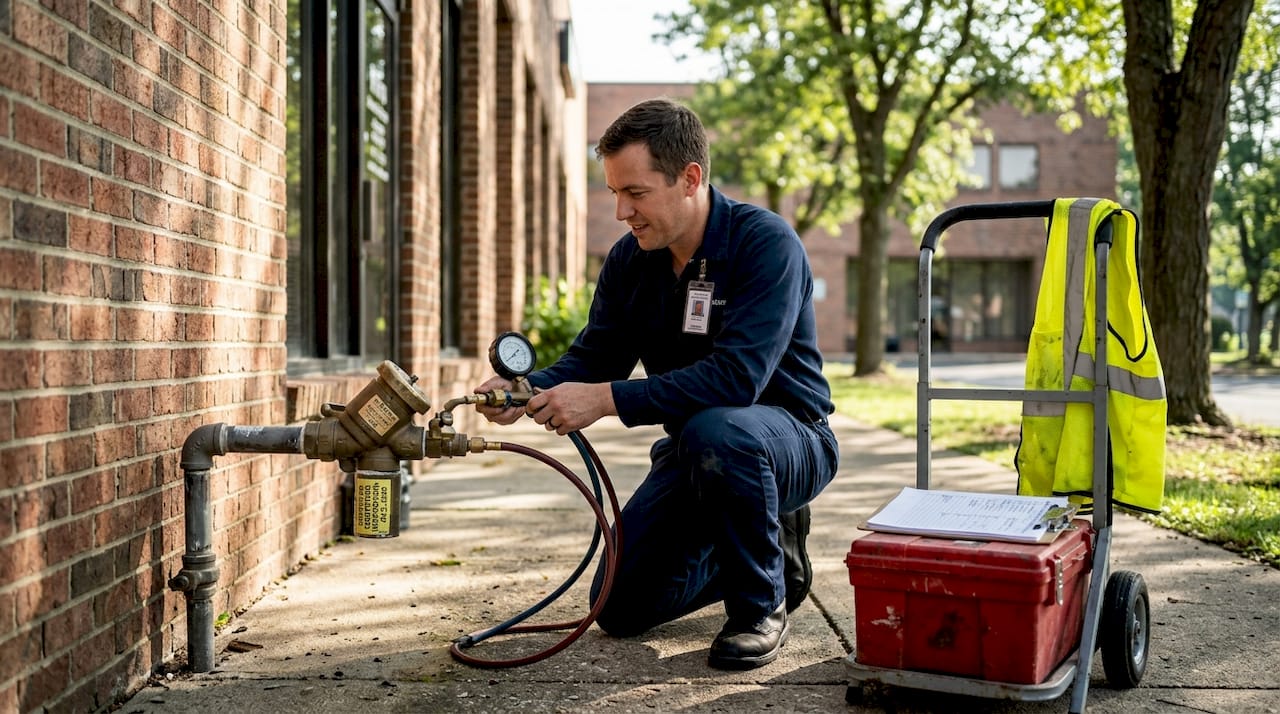
Two of the most practical questions property owners ask when scheduling their annual backflow test are: How long will the technician be here? And do I need to arrange my schedule to be present? These are fair and important questions for anyone managing a busy schedule or a commercial property with operating hours to consider. This guide answers both questions thoroughly and covers everything you need to know to prepare for your test appointment.
How Long Does the Annual Backflow Test Take?
Residential Devices: 20–45 Minutes
For a typical residential backflow preventer — a ¾-inch or 1-inch PVB, DCVA, or RPZ assembly on an irrigation system — the complete test process takes 20 to 45 minutes from arrival to departure. This includes the pre-test visual inspection, connecting test equipment, performing the differential pressure test sequence, recording results, completing the test report, and restoring the system to normal operating condition.
Commercial Devices: 30–90 Minutes
Commercial backflow preventers vary more widely in size and complexity. A 1.5-inch or 2-inch RPZ assembly typically takes 30 to 60 minutes to test. Larger assemblies (3-inch or 4-inch) may take 45 to 90 minutes. Properties with multiple devices require proportionally more time — a commercial property with three separate assemblies might need 1.5 to 2.5 hours for a complete service visit.
When Repairs Are Needed: Add 30–60 Minutes
If the device fails its initial test and requires a repair or rebuild during the same visit, add 30 to 60 minutes to the estimate for a standard residential assembly, or up to 90 minutes for a larger commercial unit. South Jersey Backflow carries rebuild kits for all major brands in our service vehicles, so same-day repair capability is the rule rather than the exception. See our guide to repair or replace your backflow preventer for more on what same-day repairs involve.
Do I Need to Be Home During the Test?
For Most Outdoor Residential Devices: Usually Not
Most residential backflow preventers in New Jersey are installed outdoors — either mounted on an exterior wall, in a ground-level valve box, or in a utility area accessible from outside the home. If the device is accessible without entering the home, the property owner typically does not need to be present. The technician can complete the test, restore the system, and leave the test report documentation in a designated location or email/text it to the property owner.
Important exception: if the irrigation system’s main shutoff or control panel is inside the home, the property owner or a designated representative must be available to provide access. Confirm the specific access needs when scheduling your appointment.
For Indoor or Restricted-Access Devices: Yes, Access Is Required
If the backflow preventer is located inside the home (in a mechanical room, utility closet, or basement), inside a locked commercial space, in a fenced equipment yard, or in an underground vault with a locked cover, someone with access must be present or must arrange access in advance. For commercial properties, the facility manager, building superintendent, or an authorized representative can provide access in lieu of the property owner.
For Commercial Properties: A Point of Contact Is Helpful
Even when physical access is straightforward, having a point of contact at commercial properties helps ensure the technician can quickly locate the device(s), get answers to any access questions, and discuss the results and any needed repairs before departing. For large properties with multiple devices, a brief walkthrough with a facilities contact can save significant time.
How to Prepare for Your Backflow Test Appointment
Know the location of your backflow preventer before the technician arrives — our guide on
How to find and identify your backflow device will help if you’re unsure
Ensure the device area is accessible and clear of obstructions — debris, equipment, or overgrown vegetation around the assembly can slow the test
For irrigation system PVBs, the irrigation system does not need to be running during the test, but the main water supply must be on
If you have records of previous test reports, have them available — the technician may want to compare this year’s readings to last year’s for trend analysis
Make sure the water main shutoff (gate valve or ball valve) at the property entrance is accessible and operational
Getting Your Test Results
After the test is complete, South Jersey Backflow provides you with a copy of the official test report — showing all differential pressure readings, pass/fail status, and any repairs performed. We submit the report directly to your water authority so you don’t have to manage the filing process. For a detailed walkthrough of what the report contains, see our guide to understanding your backflow test report.
South Jersey Backflow schedules appointments throughout all of New Jersey, Monday through Saturday, with emergency 24/7 availability. Most appointments can be set within 48 to 72 hours. contact South Jersey Backflow to schedule.
Schedule Your Backflow Service Anywhere in New Jersey
South Jersey Backflow has proudly served residential and commercial customers across all of New Jersey since 2004. Our certified technicians provide annual backflow testing and certification, expert repairs and rebuilds, and protective backflow enclosures — all with transparent pricing, complete paperwork handling, and 24/7 emergency availability. Call (856) 291-6809 or contact us online to get started today.