TL;DR:
- Regular testing by certified professionals is mandatory annually to ensure backflow devices function properly.
- Device type selection depends on property hazard level and connection purpose, with stricter requirements for high-hazard uses.
- Local water authorities may impose stricter or more frequent testing schedules beyond state minimums.
Failing a backflow inspection in New Jersey is not just a bureaucratic headache. It can mean service shutoffs, fines, and serious liability if contaminated water enters the public supply. For property owners and managers juggling multiple compliance obligations, the rules around backflow testing can feel like a moving target, especially when state requirements layer on top of local water purveyor mandates. This guide walks you through exactly what you need to know for 2026, from device types and inspection timelines to certified tester requirements and the local variations that trip up even experienced property managers.
Table of Contents
- Understanding backflow prevention and inspection basics
- Step-by-step: New Jersey inspection and testing requirements
- Choosing the right backflow prevention device for your property
- Local variations: Stricter municipal and water purveyor rules
- Our take: Why annual testing isn’t always enough in New Jersey
- Stay compliant with expert backflow testing services
- Frequently asked questions
Key Takeaways
| Point | Details |
|---|---|
| Annual inspections required | New Jersey mandates backflow device testing at installation and annually by certified professionals. |
| Certified tester necessity | Testing must be carried out by NJDEP-approved and ASSE 5000 certified testers, not just licensed plumbers. |
| Device selection by hazard | Property hazard level determines which backflow prevention device is needed for compliance. |
| Local rules may differ | Municipalities and water purveyors can enforce stricter testing frequencies, so always check local requirements. |
| Permit only for new installs | Plumbing permits are needed for new installations but not for annual testing of backflow devices. |
Understanding backflow prevention and inspection basics
Backflow is what happens when water flows in the wrong direction through your plumbing system. Under normal conditions, water pressure keeps drinking water moving from the municipal supply into your building. But pressure drops, from events like a water main break or heavy demand on the system, can reverse that flow. When that happens, contaminants from your property’s irrigation system, boiler, or industrial equipment can be pulled back into the public water supply.
That is why backflow prevention devices exist. They act as one-way gates, physically blocking reversed water from reaching the clean supply. New Jersey requires these devices on any connection that could expose the public system to a hazard.
The three main device types you will encounter are:
- Reduced Pressure Zone assembly (RPZ): The highest level of protection, required for high-hazard connections like chemical handling or hospitals.
- Double Check Valve Assembly (DCVA): Used for moderate-hazard situations, such as fire suppression systems or commercial irrigation.
- Pressure Vacuum Breaker (PVB): A lower-level device typically used for lawn irrigation where the water is not chemically treated.
Understanding which device applies to your property depends on what is connected to your water supply and the risk it poses to the public system. We will break that down further in the device selection section.
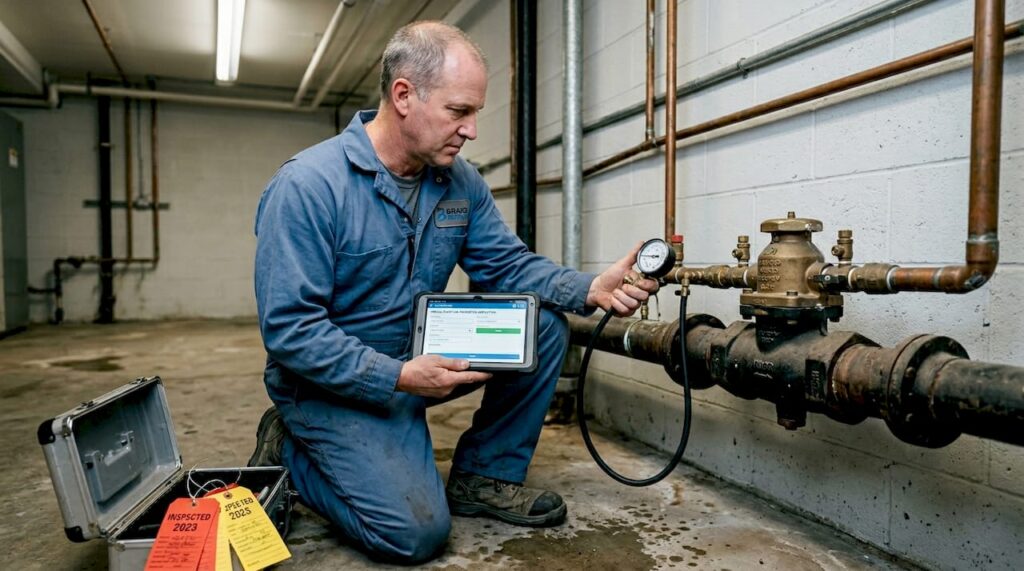
Now, knowing you have a device installed is not enough. The importance of regular testing cannot be overstated, because a device can fail silently. Seals wear out, debris clogs check valves, and springs lose tension. None of that is visible without a formal test using calibrated differential pressure gauges.
Per N.J.A.C. 7:10-10, backflow prevention assemblies on public water systems must be tested at installation and annually thereafter by certified testers, with results submitted to the water purveyor within 30 days.
This is the baseline. Missing even one annual test puts you out of compliance. Water purveyors track submission deadlines closely, and a missed filing can trigger warnings, fines, or a water service interruption. Knowing how often testing is required is step one in staying ahead of these consequences.
Step-by-step: New Jersey inspection and testing requirements
Now that the foundation is clear, here is exactly what the compliance process looks like in New Jersey for 2026. Following these steps in order keeps you protected and avoids the most common filing mistakes.
1. Determine if your property requires a backflow prevention assembly.
Any connection to a public water system that presents a potential cross-connection hazard requires a device. This includes commercial properties, multi-family buildings, irrigation systems, fire suppression systems, and any industrial or medical use.
2. Install the correct device with a permit.
New installations require a plumbing permit under the NJ Uniform Construction Code (UCC). A licensed plumber handles the installation, and a local plumbing subcode official inspects the work. This is separate from ongoing testing. You do not need a new permit for annual tests, only for the initial installation.
3. Schedule your initial test immediately after installation.
Testing at installation is mandatory, not optional. The device must be confirmed to be functioning correctly before the property goes into normal operation.
4. Hire a certified tester, not just any plumber.
This is one of the most misunderstood requirements. Testing must be performed by testers certified under approved programs such as ASSE Series 5000. A plumbing license alone does not qualify someone to test backflow prevention assemblies. You need to verify your tester holds the correct certification before the test is performed.
You can search the state’s certified device testers list to find approved testers in your area.
5. Schedule annual tests and submit results within 30 days.
Per N.J.A.C. 7:10-10, results must reach the water purveyor within 30 days of the test date. Late submissions are treated the same as missed submissions by many purveyors. Understanding the compliance submission process in detail will save you from paperwork pitfalls.

6. Repair or replace any failed devices promptly.
If a device fails the test, it must be repaired or replaced and then retested. There is no grace period for operating a failed assembly. The tester should document the failure, and you need to act fast to avoid compliance gaps.
7. Keep records on file.
Maintain copies of all test reports for your own records, even after submitting to the purveyor. Inspectors and insurers may ask for historical data going back several years.
Pro Tip: Set a recurring calendar reminder 60 days before your annual test deadline. This gives you time to schedule a certified tester, especially in spring when irrigation season drives up demand for testing appointments. Understanding the certification requirements for testers will help you ask the right questions when vetting providers.
Choosing the right backflow prevention device for your property
With testing and inspections mapped out, device selection is the next critical factor. Choosing the wrong device is a compliance failure from day one, and some property owners install lower-grade devices thinking they will pass inspection. They often do not.
New Jersey adopts the International Plumbing Code (IPC) as part of its plumbing subcode, and the IPC classifies hazards into two categories: high hazard and low hazard. Your device must match your hazard classification. Here is how the primary devices break down per hazard level under the IPC.
| Device | Hazard level | Typical use case | Testing frequency |
|---|---|---|---|
| RPZ (Reduced Pressure Zone) | High hazard | Hospitals, chemical facilities, boilers | Annual minimum |
| DCVA (Double Check Valve Assembly) | Low to moderate hazard | Fire suppression, commercial irrigation | Annual minimum |
| PVB (Pressure Vacuum Breaker) | Low hazard, non-continuous pressure | Residential and light commercial irrigation | Annual minimum |
Key factors that drive device selection:
- What is connected to the line? A chemical injection system always means high hazard, while a standard irrigation system with no additives may qualify for a PVB.
- Is the connection continuous or intermittent? PVBs cannot be used where downstream pressure remains constant, which rules them out for many commercial applications.
- Is the device installed indoors or outdoors? RPZs discharge water during pressure events, so they require floor drains or approved discharge locations.
- What does the water purveyor require? Some purveyors specify minimum device types for property categories, regardless of hazard assessment.
Refer to the full installation guide for property-specific guidance, and review the regulations overview to see how state code connects to device choice.
One common mistake: property managers assume a DCVA installed on a fire suppression system is adequate when the system uses antifreeze or chemical additives. In that scenario, the hazard level jumps to high hazard, and an RPZ becomes required. Getting this wrong means a failed inspection and potential retroactive permit issues.
Local variations: Stricter municipal and water purveyor rules
Once you understand the state-level baseline, you need to layer in local requirements. This is where many property managers get caught off guard. New Jersey’s state rules set the floor, not the ceiling. Local purveyors and municipalities may impose stricter rules or more frequent testing for high-risk sites, so you must always check with your Authority Having Jurisdiction (AHJ).
The AHJ is the local entity responsible for enforcing plumbing and water safety codes in your area. It could be your municipal water utility, a private water company, or a county authority. What they require may go significantly beyond annual testing.
| Property type | State minimum | Possible local requirement |
|---|---|---|
| Commercial irrigation | Annual | Semi-annual in drought-prone areas |
| Hospital or medical facility | Annual | Quarterly testing with detailed logs |
| Food processing plant | Annual | Monthly inspections plus annual certified test |
| Multi-family residential | Annual | Annual, but stricter device type requirements |
| Fire suppression with additives | Annual | Annual plus annual internal inspection |
Steps to stay ahead of local compliance changes:
- Contact your water purveyor directly and ask for their current backflow prevention program requirements in writing.
- Ask specifically whether your property type falls under enhanced testing schedules.
- Request notification if requirements change, as some purveyors update their programs mid-year.
- Review your water service agreement, which often references backflow compliance obligations.
- Work with a certified tester who actively monitors AHJ updates in your service area.
Some municipalities in New Jersey have adopted local ordinances that extend beyond NJDEP minimums. For example, certain industrial zones may require third-party audits of cross-connection control programs on a two-year cycle. Reviewing municipal regulation tips can help you identify what questions to ask your AHJ before a notice of violation shows up.
The practical risk is significant. If your water purveyor has a stricter schedule and you follow only the state minimum, you are still non-compliant. Fines, service shutoffs, and loss of operating licenses are all real consequences in New Jersey’s more aggressive enforcement environments.
Our take: Why annual testing isn’t always enough in New Jersey
Here is the honest assessment that many compliance guides skip over. Annual testing is the legal baseline, but for many commercial and industrial properties in New Jersey, it is not a sufficient risk management strategy.
Consider a food processing facility or a multi-tenant commercial building with aging infrastructure. A lot can happen to a backflow device in 12 months. Seal degradation, sediment buildup, and freeze damage in outdoor installations are all events that can compromise device integrity well before the next scheduled test. Waiting a full year to discover a failure is not risk management. It is just scheduled documentation.
The NJDEP acknowledges uniform state minimums, but enforcement varies significantly by purveyor. Properties that self-limit to the annual minimum and ignore local signals are the ones most likely to face sudden compliance actions.
Our recommendation: treat the annual test as your documentation checkpoint, not your only line of defense. High-risk properties should schedule informal visual inspections between certified tests, particularly after weather events, pressure fluctuations, or any plumbing work on the property. And critically, build a relationship with your AHJ. They can tell you about upcoming program changes before they become compliance deadlines. Proactive engagement with certified testers and regular checks costs far less than responding to a violation notice.
Stay compliant with expert backflow testing services
Keeping up with backflow compliance in New Jersey takes more than just knowing the rules. It takes the right partner on the ground.
South Jersey Backflow provides certified testing services for commercial, industrial, and residential properties across New Jersey, with ASSE 5000 certified testers who handle results submission to your water purveyor. Whether you need to understand your device options, catch up on missed filings, or set up a proactive testing schedule, we can help. Browse our backflow FAQ for quick answers to common questions, or review our detailed prevention methods guide to deepen your understanding of what protects your property and the public water supply.
Frequently asked questions
Who is qualified to perform backflow inspections and testing in New Jersey?
Only testers certified under ASSE Series 5000 or other NJDEP-approved programs can legally perform backflow device testing in New Jersey. A standard plumbing license does not meet this qualification.
How often must backflow prevention assemblies be inspected in NJ?
All backflow prevention assemblies must be tested at least annually, with test results submitted to the water purveyor within 30 days per N.J.A.C. 7:10-10. Some local authorities require more frequent testing.
Do I need a new permit each year for annual testing?
No. Permits are only required for new device installations under the NJ Uniform Construction Code. Routine annual testing does not trigger a new permit requirement.
Can local municipalities require more frequent inspections than the state minimum?
Yes. Local water purveyors and municipalities are authorized to set stricter or more frequent testing requirements, particularly for high-risk property types. Always verify requirements directly with your AHJ.
Which backflow prevention device should I use for my NJ property?
Device selection is determined by hazard level and property type under the IPC as adopted in the NJ plumbing subcode. RPZ assemblies cover high-hazard connections, DCVAs handle moderate-hazard situations, and PVBs apply to lower-risk residential and light commercial irrigation.
Pingback: Seasonal Plumbing Maintenance Tips for NJ Property Owners
Pingback: Certified Backflow Tester Explained: NJ Compliance Made Simple
Pingback: NJ backflow codes: your compliance roadmap for 2026
Pingback: Top ways to improve plumbing safety for NJ properties
Pingback: How to spot faulty backflow valves: key indicators for NJ owners
Pingback: How to Find, Test, and Maintain Backflow Preventers in NJ
Pingback: NJ fire sprinkler backflow: Stay compliant and safe
Pingback: Backflow inspection: Protect your NJ water supply
Pingback: Water system safety checklist for NJ backflow owners